What is the optimal salt level? For health, longer cell lifespan, and maximum performance of your salt chlorinator, 3,000–3,500 ppm is the ideal range.
Last updated: 2 Dec 2025
5506 Views
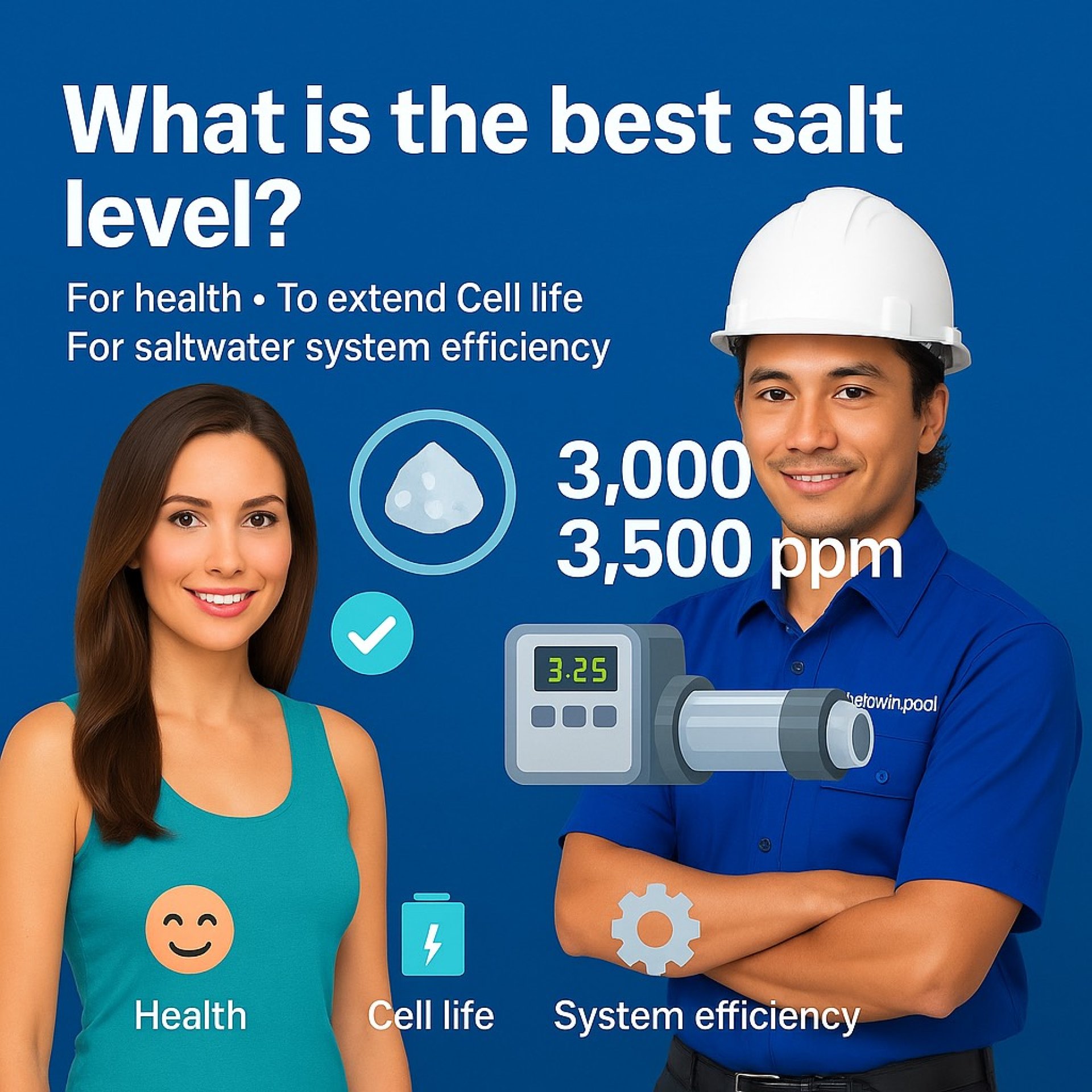
What Is the Best Salt Level?
For health To extend Cell life For maximum performance of your salt chlorinator
Different salt chlorinator brands require different salt levels such as 2,700-3,400 ppm, 3,000-4,000 ppm, or even up to 5,000 ppm.
However, the ideal range for both the swimmer and the machine is 3,000-3,500 ppm.
Below are the four complete engineering reasons, along with a real example.
Why 3,000-3,500 ppm is the Best Salt Range for Salt Chlorinators
(including models requiring 3,000-4,000 ppm such as Laswim)
1) Optimal Electrical Conductivity
Salt in the water acts as the conductor for the Salt Cell.
If the salt level is below 3,000 ppm electrical flow becomes weak the machine increases current the Cell overheats shorter lifespan
If the salt level is above 3,500-4,000 ppm electrical flow becomes too strong excessive current Cell surface erodes faster and generates excessive heat
The 3,0003,500 ppm range provides the perfect electrical balance.
Electricity flows smoothly, the machine works without strain, and no unnecessary heat is generated.
2) Highest Electrolysis Efficiency
Chlorine production depends on an adequate amount of chloride ions (Cl).
Low salt insufficient ions machine must increase power Cell degrades faster
High salt increases unwanted side reactions, such as scaling and corrosion
At 3,0003,500 ppm, the Cell produces the most chlorine per unit of electrical power.
This means lower energy consumption and reduced stress on the machine.
3) Safe Operating Temperature of the Cell (Thermal Stability)
Salt Cells are made of titanium with ruthenium coating and high heat destroys this coating quickly.
Low salt machine pushes more current Cell becomes very hot
High salt excess current hot spots on the Cell surface
3,0003,500 ppm keeps the Cell temperature below the damage threshold of the coating,
which significantly extends Cell lifespan.
4) Minimized Scale Formation on the Cell
Calcium scale and salt deposits occur more easily when:
Salt level is high
Temperature is high
Electrical current is excessive
These deposits cause:
Reduced chlorine production
More frequent Cell cleaning
Faster coating erosion
At 3,000-3,500 ppm, scale forms more slowly, and the Polarity Reverse function can clean the Cell most effectively.
This results in longer Cell life and reduced maintenance.
Real Example: Laswim Salt Chlorinator
Laswim imported by Winwinpool requires 3,000-4,000 ppm,
which is the global standard range for high-quality salt chlorinators.
In real-world use:
The best setting is 3,000-3,500 ppm,
which sits right in the middle of Laswims specification.
This ensures:
Stable system performance
Consistent chlorine production
Longer Cell lifespan
Less scale build-up
Lower energy usage
More comfortable swimming (not too salty)
The Ideal Salt Level for All Salt Chlorinators (including Laswim): 3,000-3,500 ppm
This range is optimal because it provides:
Balanced electrical conductivity machine does not overwork
Maximum chlorine production efficiency lower power consumption
Safe temperature on the Cell surface extends coating life
Minimal scale formation less cleaning and slower wear
Summary
If you are using Laswim, set the salt level to 3,200-3,500 ppm
(approx. 3.5 kg of salt per 1 m³ of water)
This is the sweet spot the best for swimmers, the Cell, and the machines long-term performance.
Shop Salt Chlorinators Designed to Work Best at the Ideal 3,000-3,500 ppm Range:
(You can insert your product link or banner here)
For health To extend Cell life For maximum performance of your salt chlorinator
Different salt chlorinator brands require different salt levels such as 2,700-3,400 ppm, 3,000-4,000 ppm, or even up to 5,000 ppm.
However, the ideal range for both the swimmer and the machine is 3,000-3,500 ppm.
Below are the four complete engineering reasons, along with a real example.
Why 3,000-3,500 ppm is the Best Salt Range for Salt Chlorinators
(including models requiring 3,000-4,000 ppm such as Laswim)
1) Optimal Electrical Conductivity
Salt in the water acts as the conductor for the Salt Cell.
If the salt level is below 3,000 ppm electrical flow becomes weak the machine increases current the Cell overheats shorter lifespan
If the salt level is above 3,500-4,000 ppm electrical flow becomes too strong excessive current Cell surface erodes faster and generates excessive heat
The 3,0003,500 ppm range provides the perfect electrical balance.
Electricity flows smoothly, the machine works without strain, and no unnecessary heat is generated.
2) Highest Electrolysis Efficiency
Chlorine production depends on an adequate amount of chloride ions (Cl).
Low salt insufficient ions machine must increase power Cell degrades faster
High salt increases unwanted side reactions, such as scaling and corrosion
At 3,0003,500 ppm, the Cell produces the most chlorine per unit of electrical power.
This means lower energy consumption and reduced stress on the machine.
3) Safe Operating Temperature of the Cell (Thermal Stability)
Salt Cells are made of titanium with ruthenium coating and high heat destroys this coating quickly.
Low salt machine pushes more current Cell becomes very hot
High salt excess current hot spots on the Cell surface
3,0003,500 ppm keeps the Cell temperature below the damage threshold of the coating,
which significantly extends Cell lifespan.
4) Minimized Scale Formation on the Cell
Calcium scale and salt deposits occur more easily when:
Salt level is high
Temperature is high
Electrical current is excessive
These deposits cause:
Reduced chlorine production
More frequent Cell cleaning
Faster coating erosion
At 3,000-3,500 ppm, scale forms more slowly, and the Polarity Reverse function can clean the Cell most effectively.
This results in longer Cell life and reduced maintenance.
Real Example: Laswim Salt Chlorinator
Laswim imported by Winwinpool requires 3,000-4,000 ppm,
which is the global standard range for high-quality salt chlorinators.
In real-world use:
The best setting is 3,000-3,500 ppm,
which sits right in the middle of Laswims specification.
This ensures:
Stable system performance
Consistent chlorine production
Longer Cell lifespan
Less scale build-up
Lower energy usage
More comfortable swimming (not too salty)
The Ideal Salt Level for All Salt Chlorinators (including Laswim): 3,000-3,500 ppm
This range is optimal because it provides:
Balanced electrical conductivity machine does not overwork
Maximum chlorine production efficiency lower power consumption
Safe temperature on the Cell surface extends coating life
Minimal scale formation less cleaning and slower wear
Summary
If you are using Laswim, set the salt level to 3,200-3,500 ppm
(approx. 3.5 kg of salt per 1 m³ of water)
This is the sweet spot the best for swimmers, the Cell, and the machines long-term performance.
Shop Salt Chlorinators Designed to Work Best at the Ideal 3,000-3,500 ppm Range:
(You can insert your product link or banner here)


Tags :
Related Content

Discover how saltwater pools work, why many families enjoy them, and what you still need to check to keep the water comfortable and safe.


Chlorine 90% is an essential primary sanitizer for every swimming pool, regardless of whether it uses a salt system, mineral system, ionizer, ozone, UV, or other health-oriented treatment systems. These systems function as secondary sanitizers and cannot kill bacteria as rapidly as chlorine. If the water becomes cloudy, develops an odor, or experiences heavy usage, chlorine should be added immediately to restore water quality. Maintain a minimum chlorine level of 0.5 ppm to protect swimmers from newly introduced contaminants. Keeping chlorine in stock ensures your pool remains safe at all times. Store chlorine in a dry area, tightly sealed, and away from moisture. If you need guidance on dosage or product selection, feel free to ask anytime.
