Leaving Home for 7-10 Days During the New Year How to Maintain Your Swimming Pool So Its Clear and Ready to Swim When You Return
Leaving Home for 7-10 Days During the New Year
How to Maintain Your Swimming Pool So Its Clear and Ready to Swim When You Return
The New Year holiday is a time when many families travel to other provinces or overseas. When a house is left unoccupied for several daysespecially homes with swimming poolsa common question often arises:
If no one is home for 7-10 days, how should the swimming pool be maintained?
Many homeowners worry that the water will turn green, develop odors, or require a full pool cleaning and water replacement upon returnresulting in unnecessary time and cost.
This article explains the correct principles and methods for closing a swimming pool for 10 days, without daily maintenance, and how these methods can be adapted to different types of homes.
Fundamental Principles of Pool Water During Periods of No Use
From a water treatment perspective, pool water quality changes due to three main factors:
1. Microorganisms, Bacteria, and Algae
These develop from sunlight, heat, and nutrients in the water. Even when no one is swimming, algae can still grow.
2. Suspended Dirt and Sediment
Dust, leaves, and rain particles gradually accumulate, causing water to become cloudy over time.
3. Water Circulation
When water remains stagnant for long periods, contaminants tend to accumulate in certain areas, reducing the effectiveness of disinfection.
Therefore, proper pool closure is not just about turning the system off, but about preparing the water so it can maintain its quality throughout the 7-10 day period.
The Concept Behind the 10-Day Pool Closure Formula
This pool care method is designed for:
Homes that are unoccupied for several days
Homes that cannot control pool systems via Smart Home or Smart Apps
Homeowners who want to return without having to replace pool water
The core idea is:
Let chemicals do the work instead of people,
and reduce the risk of running electrical systems while no one is home.
Chemical dosing must always be based on pool size.
The formula described below is an example for a residential pool of approximately 50 cubic meters (50 m³).
If the pool size differs, chemical quantities should be adjusted accordingly.
One-Time Pool Treatment Formula Effective for 10 Days
1. Algae Control and Prevention
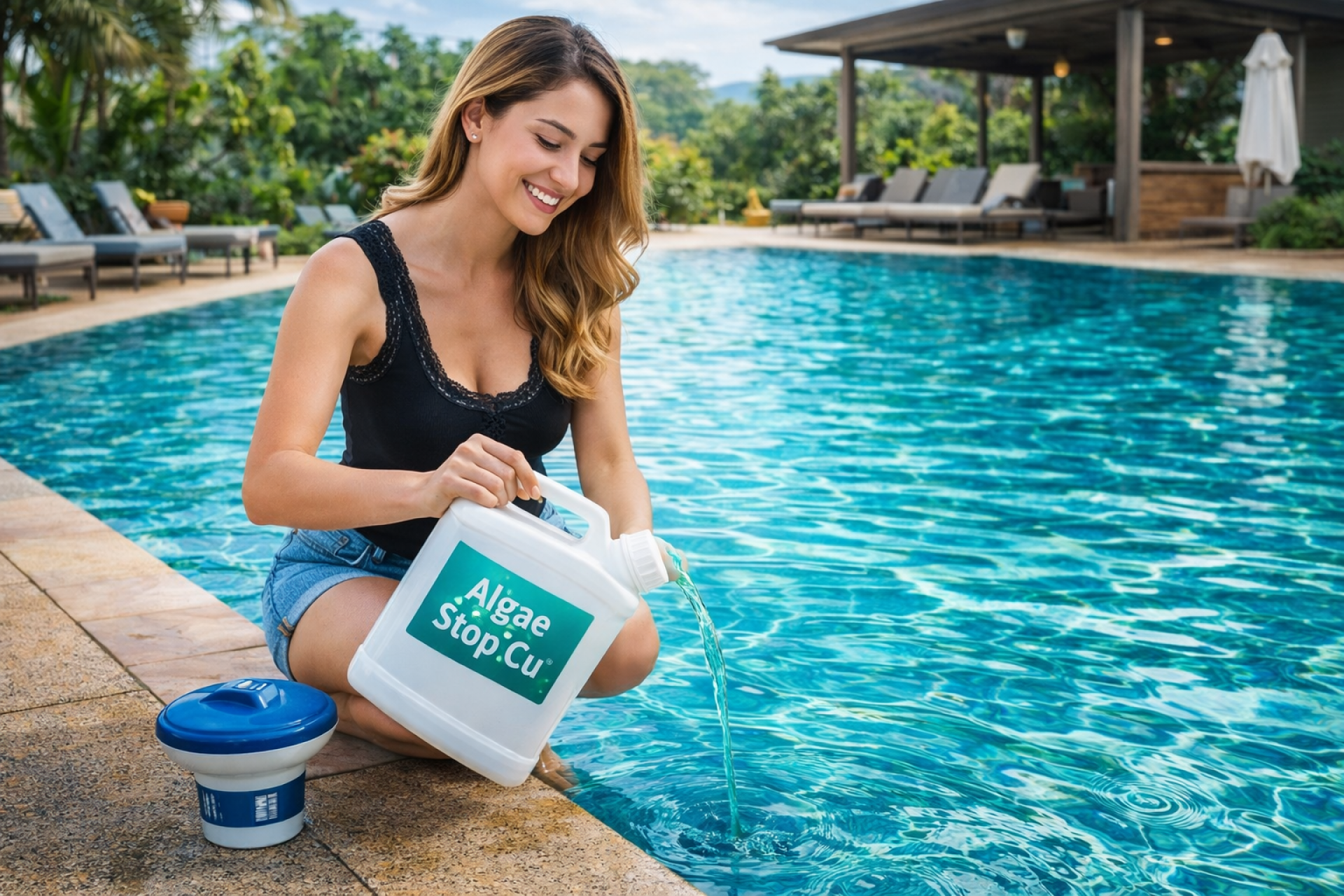
Algae Stop Cu 1 liter per 50 m³ pool
Under normal conditions, the standard dosage is:
1 liter per 100 m³, or
0.5 liter per 50 m³
However, when closing the pool for 7-10 days, it is recommended to increase the dosage to 1 liter per 50 m³.
This ensures continuous algae inhibition throughout the unattended period and reduces the risk of green water caused by sunlight, rain, and heat.
2. Water Clarification and Sedimentation
Liquid Flocculant 1 liter per 50 m³ pool
According to physical principles, very fine particles in water carry electrical charges, allowing them to remain suspended instead of settling.
Liquid flocculant neutralizes these charges, causing small particles to combine into larger clusters that sink to the pool floor.
Results include:
Reduced water cloudiness
Dirt and debris settling at the bottom
Upon return, simply vacuum the sediment to restore clear waterno water replacement needed
3. Long-Term Disinfection with Chlorine
Chlorine Tablets 200 g 3" tablets per 50 m³ pool
Effective disinfection does not require excessively strong chlorine levels, but rather consistent chlorine presence.
Slow-dissolving chlorine tablets placed in a floating dispenser provide steady chlorine release every day.
Under normal conditions, a 50 m³ pool typically uses about 2 tablets.
For extended closure periods, it is recommended to increase this to 3 tablets, ensuring adequate sanitation for the full 10 days.
Pool System Management Based on Home Type
Case 1: Homes Without Automatic Control Systems
If the pool system cannot be monitored or controlled via mobile devices:
It is recommended to turn off the pump and all pool systems.
From a safety standpoint, operating electrical equipment without supervision poses more risk than benefit.
The chemical treatment applied beforehand will maintain water quality throughout the 710 day period.
Case 2: Homes with Smart Home / Smart App Systems
If the pool system can be monitored and controlled remotely:
It is recommended to operate only the circulation pump.
This allows minimal water circulation to help distribute chemicals evenly.
Salt chlorination systems and other automatic systems can be turned off.
In this case, the same 10-day pool closure formula can still be applied.
Reopening the Pool After Returning Home
After returning, follow these steps:
Vacuum the sediment that has settled on the pool floor
Test the chlorine level in the water
Residential pool standard: 1-3 ppm
Up to 4 ppm is still safe for swimming
If chlorine levels are too high:
Drain approximately 10% of the pool water
Refill with fresh water and test again
In general, because this method uses slow-dissolving chlorine, chlorine levels will not spike beyond safe limits.
Conclusion
Closing a swimming pool for 7-10 days during the New Year holiday does not have to be complicated.
With proper understanding and correct water preparation from the start, pool water can remain clean and balanced.
Whether or not your home has a Smart system, choosing the right chemicals in the correct quantities ensures that when you return from your trip, your swimming pool will be clear, clean, and ready to enjoywithout draining or replacing the water.