Share

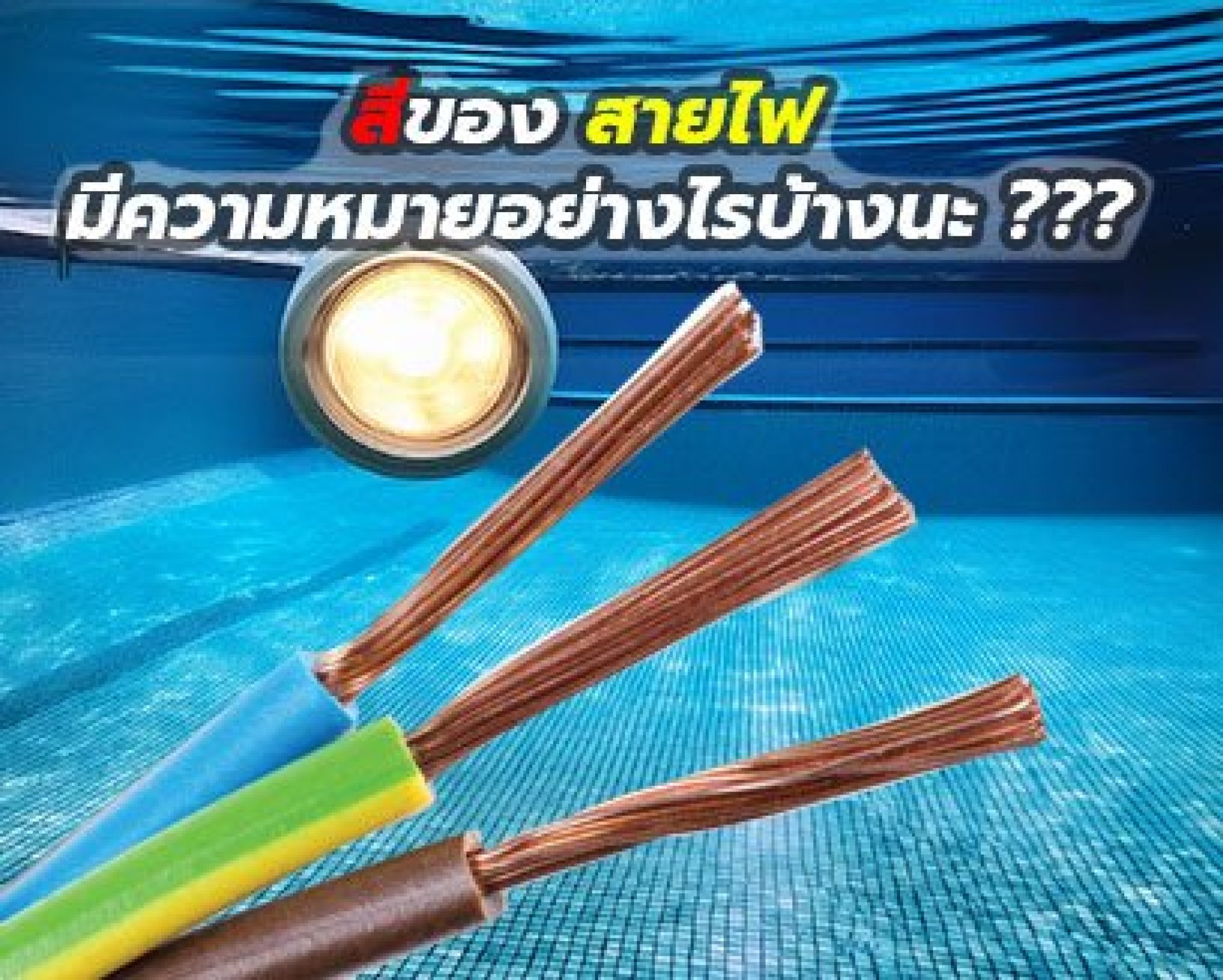
What do the colors of the wires mean?
Last updated: 2 Dec 2025
1258 Views

Electrical Wire Color Standards 

          Currently, electrical wire color standards have changed to use TIS 11-2553 (MOG), replacing the original standard TIS 11-2531. The reason for this change is that the Thai Industrial Standards Institute (TISI) aims for both industrial and household wiring in Thailand to meet international standards (IEC 60227 Standards).
      Many people may wonder if each wire color has a specific meaning. This article will help resolve these doubts by explaining the meaning of each wire color for easier and safer application.

Black (Changed to Brown) refers to the hot wire or the wire carrying current to the entire circuit; usually supplies power to outlets or electrical switches.

Red (Changed to Black)  refers to the second hot wire for large electrical appliances such as air conditioners, ovens, televisions, etc.

Blue and Yellow (Changed to Grey)  refers to hot wires used with portable electrical devices utilizing general plugs, such as fans, lamps, vacuum cleaners, etc.

White or Grey (Changed to Blue)  refers to the Neutral wire, which is essential for the safety of electrical appliances.

Green refers to the Ground wire, which helps prevent electric shock and protects against dangers from short circuits or fires.

According to Thai standards, wire colors can be classified as follows:


Wire Colors 

Black (Changed to Brown) means  L or L1, Positive Current Wire 1 (Live 1) 
Red (Changed to Black) means L2, Positive Current Wire 2 (Live 2) 
Blue (Changed to Grey) means L3, Positive Current Wire 3 (Live 3) 
White or Grey (Changed to Blue) means N, Low Voltage Negative Potential (Neutral) 
Green or Green/Yellow Stripe (Designated as Green/Yellow) means G, Ground Wire, helping prevent danger from short circuits or fires. 
 

Differences between Single-Phase and 3-Phase Systems 

Single-Phase System ( 220 V ) 

Live Wire (L) insulation is Brown 
Neutral Wire (N) insulation is Blue 
Ground Wire (G) insulation is Green with Yellow Stripe 

3-Phase System ( 380 V ) 

Live Wire (L1) insulation is Brown 
Live Wire (L2) insulation is Black 
Live Wire (L3) insulation is Grey 
Neutral Wire (N) insulation is Blue 
Ground Wire (G) insulation is Green with Yellow Stripe


Related Content
⭐ **WATERSTOP for Swimming Pool Construction Selection Guide + Specifications (Winwinpool Standard by Pool Size & Concrete Thickness)**
⭐ How to Choose the Right Waterstop for Swimming Pools Selecting the proper waterstop is essential for preventing leakage through concrete joints in swimming pool structures, including floor-to-wall joints, construction joints, and areas with structural movement such as expansion joints. Choosing the correct size and thickness helps ensure long-term waterproofing performance and extends the overall lifespan of the pool. The selection should always match the thickness of the pool wall or slab. For example, 6-inch waterstops are suitable for 15–20 cm concrete walls, while 8-inch models are recommended for 20–25 cm walls. Rib design and thickness are equally important: triple-rib models provide stronger anchorage and are ideal for high-pressure or movement-prone areas, whereas double-rib models suit general construction joints. Winwinpool classifies its waterstops into six types—Type A, AA, B, BB, C, and CC—allowing engineers, contractors, and homeowners to select the most appropriate model according to structural requirements and pool design standards.
Why Every Swimming Pool Needs 90% Chlorine?
Chlorine 90% is an essential primary sanitizer for every swimming pool, regardless of whether it uses a salt system, mineral system, ionizer, ozone, UV, or other health-oriented treatment systems. These systems function as secondary sanitizers and cannot kill bacteria as rapidly as chlorine. If the water becomes cloudy, develops an odor, or experiences heavy usage, chlorine should be added immediately to restore water quality. Maintain a minimum chlorine level of 0.5 ppm to protect swimmers from newly introduced contaminants. Keeping chlorine in stock ensures your pool remains safe at all times. Store chlorine in a dry area, tightly sealed, and away from moisture. If you need guidance on dosage or product selection, feel free to ask anytime.
Why You Should Never Use Exposed Aggregate (Washed Sand Finish) Inside a Swimming Pool
Why You Should Never Use Exposed Aggregate (Washed Sand Finish) Inside a Swimming Pool Using exposed aggregate or washed sand finish inside the pool is strongly discouraged because chlorine and pool chemicals gradually erode the surface, causing sand particles to loosen and detach. These particles are then carried by the water flow into the filtration system, where they often get stuck in the pump impeller, leading to wear, reduced performance, and costly pump damage. Additionally, exposed aggregate surfaces retain algae, are difficult to clean, and the rough texture may cause scratches or abrasions to swimmers. As the surface deteriorates, loose particles make the pool water cloudy and increase the frequency of maintenance, driving up long-term operating costs. ✅ Recommendation
icon-messenger
เว็บไซต์นี้มีการใช้งานคุกกี้ เพื่อเพิ่มประสิทธิภาพและประสบการณ์ที่ดีในการใช้งานเว็บไซต์ของท่าน ท่านสามารถอ่านรายละเอียดเพิ่มเติมได้ที่ Privacy Policy and Cookies Policy
Compare product
0/4
Remove all
Compare