Share

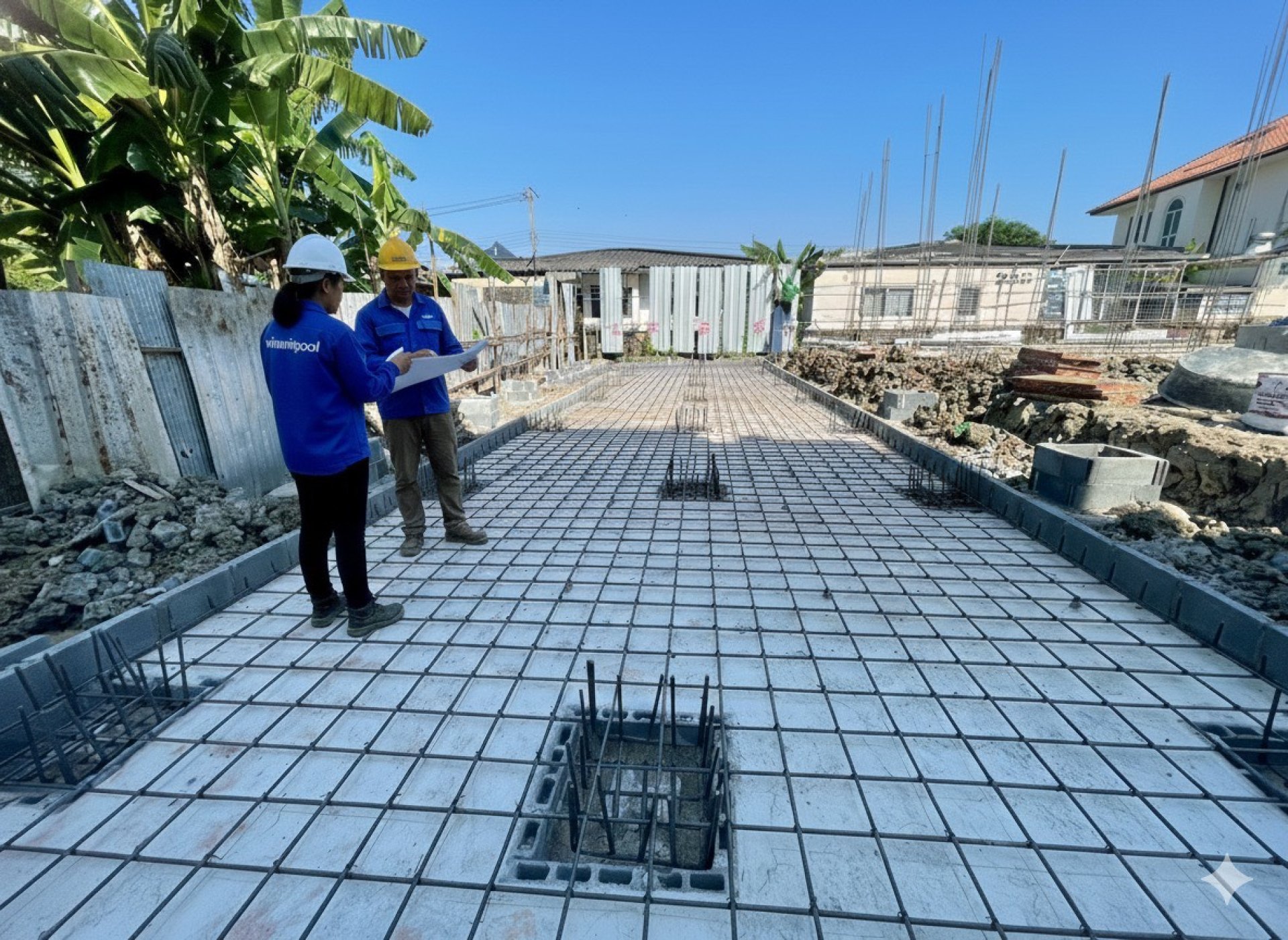
What is a Drop Panel? A Drop Panel is a section of the concrete slab that is thickened specifically around the column area. It appears as a depressed (lowered) area or a thickened wing surrounding the column reinforcement. Its purposes are to: Increase
Last updated: 3 Dec 2025
1260 Views


Why a Well-Constructed Swimming Pool Needs Drop Panels How Are They Better Than a Regular Slab or Footing?


What Is a Drop Panel?
A drop panel is a thickened slab area around the column.
It increases the slab thickness only at specific points where structural loads are highest.
In your photos, it appears as a deeper box-like area with denser reinforcement around the column.


Why Do Swimming Pools Need Drop Panels?

1.They Significantly Increase Load-Bearing Capacity

The area around columns receives the highest shear force and bending moment,
especially in a swimming pool where thousands of kilograms of water weight press down continuously.

Without a drop panel, the slab may:

Crack
Sag over time
Fail in shear (which is the most dangerous structural failure)
A drop panel strengthens only the necessary area, increasing the shear capacity dramatically.

2. Prevents Water Leakage
Column junctions are one of the most critical points in pool construction.

Why? Because:

They carry very high loads
If cracks occur water will leak immediately
Drop panels increase slab thickness and reinforcement, making this zone much stronger and reducing leakage risk.


3. Controls Long-Term Cracking


The added thickness + multi-directional reinforcement around the column helps prevent cracking over 520 years.

Pools without drop panels often experience:

Cracks around columns
Leakage along the joint
Slight slab settlement (sagging)

4. More Efficient and Economical


Without drop panels, the alternative is to make the entire slab thicker (510 cm thicker everywhere).

That:

Uses more concrete
Costs more
Is unnecessary
Drop panels allow the structure to be strong only where it needs to be more efficient and economical.


Drop Panel vs. Footing (Column Pedestal)
Item


Drop Panel
Footing (Column Pedestal)
Purpose
Strengthens slab around the column
Transfers column load to the foundation
Location
Part of the slab (on top of the floor structure)
Beneath the column, on soil or piles
Function
Increases shear/bending resistance
Supports the column vertically
Used in pools?
Yes, in quality reinforced pool construction
Only depending on structural design
Summary
Drop panel = strengthens the pool slab
Footing = strengthens the vertical column foundation

They are not the same, but they work together.


How Drop Panels Are Better Than Not Having Them
With Drop Panels
Stronger pool structure
Better water-tightness
Reduced cracking
Prevents slab sagging
Meets engineering standards
Saves cost by avoiding thicker slabs everywhere
Without Drop Panels
Higher risk of cracking
Leakage around the column area
Slab deformation over time
Hard-to-repair structural problems
Some engineers will not approve the design

The Simplest Explanation
A drop panel is the stiff neck of the pool slab.
Without it, its like building a house where beams do not properly support the columns risky and structurally unsafe.

In the photos , the reinforcement and drop panel construction look correct and professionally done.


Related Content
 “Salt Chlorinator Cell Housing Cracked… The Real Cause Is NOT a Bad Machine — It’s When the Unit Runs Without Water Flow!” Many pool owners experience this and get shocked…
A cracked or burst salt chlorinator cell housing is a problem that shocks many pool owners. The chlorinator appears to be running normally, but suddenly you hear a loud “pop,” followed by water leaking from the system. Many people assume the unit is low quality, but in most cases, the real cause is not the machine itself — it is when the salt chlorinator continues operating without actual water flow through the cell. Even when water is not flowing, salt water may still remain trapped inside the cell housing. If the chlorinator keeps producing chlorine from this trapped water, chlorine quickly turns into chlorine gas. The gas pressure builds up rapidly inside the housing, which can eventually crack or explode the clear plastic outer chamber. The most common situations include: (1) closing the inlet and outlet valves during pool vacuuming to prevent sediment from entering the cell, then forgetting to reopen them; and (2) running filter backwash in AUTO mode where the pump and chlorinator operate together, but the water flows directly to the waste line instead of passing through the cell. This issue is especially common in models that use electrode-type water sensing, which can be inaccurate when water is trapped but not flowing. The best solution is choosing a salt chlorinator with a real Flow Switch, such as the Laswim SR Series. A Flow Switch instantly stops operation when there is no real water flow, significantly reducing the risk of cracking, leakage, and costly repairs while extending the equipment lifespan.
Leaving Home for 7-10 Days During the New Year How to Maintain Your Swimming Pool So Its Clear and Ready to Swim When You Return
The New Year holiday is a time when many families travel to other provinces or overseas, leaving their homes unoccupied for several days. For homeowners with swimming pools, this often leads to concerns that the water may turn green, develop unpleasant odors, or require costly cleaning and water replacement upon return. In reality, closing a swimming pool for 7–10 days is not difficult if the correct water care principles are applied. The key is proper water preparation before leaving, using the right chemicals to work in place of daily maintenance. This approach helps control algae growth, bacteria, and the accumulation of dirt during periods when the pool is not in use. This one-time, 10-day pool care method is designed for residential pools and can be applied to both homes without automatic control systems and those equipped with Smart Home or Smart App monitoring. It allows pool owners to reduce system operation while still maintaining stable water quality throughout the holiday period. When chemicals are selected correctly and adjusted according to pool size, homeowners can return from their trip to find clear, clean water. With minimal effort—such as vacuuming settled debris—the pool is ready for immediate use, eliminating the need for draining or refilling and ensuring a stress-free return home.
⭐ **WATERSTOP for Swimming Pool Construction Selection Guide + Specifications (Winwinpool Standard by Pool Size & Concrete Thickness)**
⭐ How to Choose the Right Waterstop for Swimming Pools Selecting the proper waterstop is essential for preventing leakage through concrete joints in swimming pool structures, including floor-to-wall joints, construction joints, and areas with structural movement such as expansion joints. Choosing the correct size and thickness helps ensure long-term waterproofing performance and extends the overall lifespan of the pool. The selection should always match the thickness of the pool wall or slab. For example, 6-inch waterstops are suitable for 15–20 cm concrete walls, while 8-inch models are recommended for 20–25 cm walls. Rib design and thickness are equally important: triple-rib models provide stronger anchorage and are ideal for high-pressure or movement-prone areas, whereas double-rib models suit general construction joints. Winwinpool classifies its waterstops into six types—Type A, AA, B, BB, C, and CC—allowing engineers, contractors, and homeowners to select the most appropriate model according to structural requirements and pool design standards.
icon-messenger
เว็บไซต์นี้มีการใช้งานคุกกี้ เพื่อเพิ่มประสิทธิภาพและประสบการณ์ที่ดีในการใช้งานเว็บไซต์ของท่าน ท่านสามารถอ่านรายละเอียดเพิ่มเติมได้ที่ Privacy Policy and Cookies Policy
Compare product
0/4
Remove all
Compare