What is a Drop Panel? A Drop Panel is a section of the concrete slab that is thickened specifically around the column area. It appears as a depressed (lowered) area or a thickened wing surrounding the column reinforcement. Its purposes are to: Increase
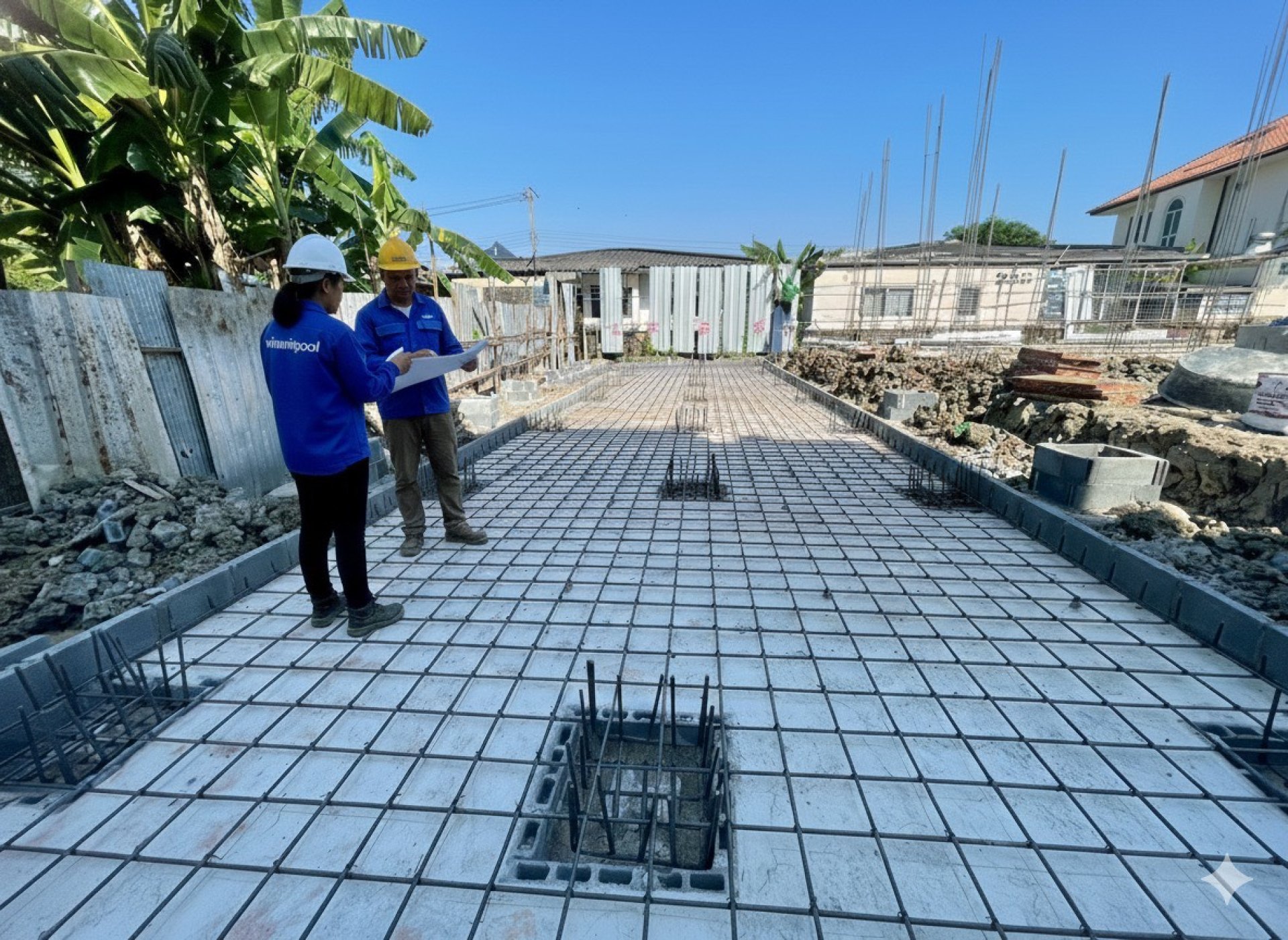
Why a Well-Constructed Swimming Pool Needs Drop Panels How Are They Better Than a Regular Slab or Footing?
What Is a Drop Panel?
A drop panel is a thickened slab area around the column.
It increases the slab thickness only at specific points where structural loads are highest.
In your photos, it appears as a deeper box-like area with denser reinforcement around the column.
Why Do Swimming Pools Need Drop Panels?
1.They Significantly Increase Load-Bearing Capacity
The area around columns receives the highest shear force and bending moment,
especially in a swimming pool where thousands of kilograms of water weight press down continuously.
Without a drop panel, the slab may:
Crack
Sag over time
Fail in shear (which is the most dangerous structural failure)
A drop panel strengthens only the necessary area, increasing the shear capacity dramatically.
2. Prevents Water Leakage
Column junctions are one of the most critical points in pool construction.
Why? Because:
They carry very high loads
If cracks occur water will leak immediately
Drop panels increase slab thickness and reinforcement, making this zone much stronger and reducing leakage risk.
3. Controls Long-Term Cracking
The added thickness + multi-directional reinforcement around the column helps prevent cracking over 520 years.
Pools without drop panels often experience:
Cracks around columns
Leakage along the joint
Slight slab settlement (sagging)
4. More Efficient and Economical
Without drop panels, the alternative is to make the entire slab thicker (510 cm thicker everywhere).
That:
Uses more concrete
Costs more
Is unnecessary
Drop panels allow the structure to be strong only where it needs to be more efficient and economical.
Drop Panel vs. Footing (Column Pedestal)
Item
Drop Panel
Footing (Column Pedestal)
Purpose
Strengthens slab around the column
Transfers column load to the foundation
Location
Part of the slab (on top of the floor structure)
Beneath the column, on soil or piles
Function
Increases shear/bending resistance
Supports the column vertically
Used in pools?
Yes, in quality reinforced pool construction
Only depending on structural design
Summary
Drop panel = strengthens the pool slab
Footing = strengthens the vertical column foundation
They are not the same, but they work together.
How Drop Panels Are Better Than Not Having Them
With Drop Panels
Stronger pool structure
Better water-tightness
Reduced cracking
Prevents slab sagging
Meets engineering standards
Saves cost by avoiding thicker slabs everywhere
Without Drop Panels
Higher risk of cracking
Leakage around the column area
Slab deformation over time
Hard-to-repair structural problems
Some engineers will not approve the design
The Simplest Explanation
A drop panel is the stiff neck of the pool slab.
Without it, its like building a house where beams do not properly support the columns risky and structurally unsafe.
In the photos , the reinforcement and drop panel construction look correct and professionally done.