วิธีคำนวณจำนวนหัวจ่ายน้ำดีสระว่ายน้ำ: Skimmer กับ Overflow ต่างกันอย่างไร และต้องดูขนาดปั๊มด้วยหรือไม่?
How to Calculate the Number of Pool Return Inlets: Skimmer vs Overflow and Does Pump Size Matter?
Return inlets are the points where filtered, treated water flows back into the pool. The right number does not depend on pool area or pump horsepower alone you need to consider water volume, actual circulation rate, inlet capacity and even water distribution to prevent dead zones.
Key Takeaways in 30 Seconds
- Always start with Required flow = Water volume ÷ Turnover time
- Use the actual pump flow from the pump curve at the operating TDH not just HP
- Number of inlets = the larger of the flow criterion and the area/distribution criterion
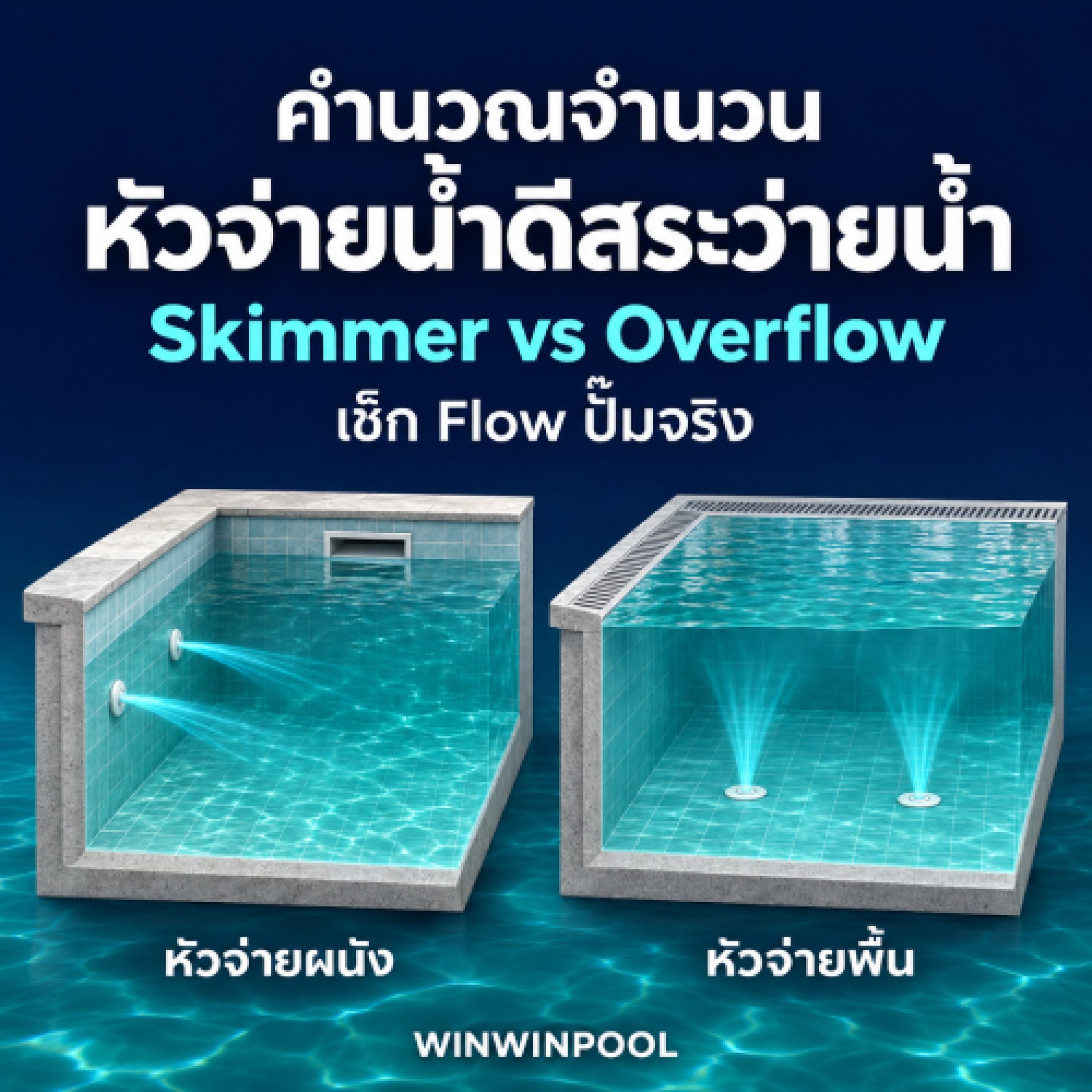
- Skimmer pools typically use wall inlets; upflow overflow pools typically use floor inlets but neither is a fixed rule
1How Do Inlet Choices Differ Between Skimmer and Overflow Pools?
| Pool Type | Common Inlet Type | Key Considerations |
|---|---|---|
| Skimmer | Wall Return Inlet | Aim the flow to circulate across the whole pool, avoid short-circuiting into the skimmer, and check dead corners and steps |
| Overflow Upflow | Floor Return Inlet | Distributes water evenly from the floor upward, carrying surface water into the overflow gutter |
| Overflow Wall Flow | Wall inlets | Works if positioned to mix the water thoroughly and push surface debris toward the overflow gutter |
| Overflow Mixed | Combination of floor and wall inlets | Requires a designed flow split and balancing valves for each group |
2Information You Need Before Calculating
Length (L), width (W), shallow-end and deep-end depth
Skimmer / overflow and the target turnover time
HP, actual flow from the pump curve at TDH, and the filter’s maximum flow
Rated flow of each inlet model, steps, benches, recesses, special shallow/deep zones
For a rectangular pool with a uniformly sloping floor, estimate the volume as follows:
Do not apply this formula directly to freeform, multi-level or irregular-section pools calculate each zone separately.
3Calculate the Filtration Flow Rate
Qrequired = 70 ÷ 6 = 11.67 m³/h
The 6-hour turnover is an assumption for this example only it does not replace the requirements for public, hotel or special-purpose pools.
4Why Pump Flow Matters More Than HP
Two 1 HP pumps can deliver very different flow rates because of differences in impeller, volute, pipe length, fittings, filter and overall system resistance. Horsepower alone cannot confirm actual flow. [5]
The calculator lets you select HP for a quick first pass, but real design work requires the operating-point flow from the pump curve or a reliable measurement. Once you enter the actual pump flow, the tool warns you if Qpump is lower than Qrequired and uses the value below to size the inlets, so you never end up with too few inlets for the flow actually in use.
5Calculating Wall Return Inlets
Choose an inlet with manufacturer flow data, then calculate:
Maximum recommended flow under the conditions stated in the manufacturer’s documentation [4]
roundup(13 ÷ 4.5) = 3 inlets (flow-based minimum). You still need to check spacing and placement for full-pool coverage.
For comparison, ISPSC 2024 requires at least one return inlet per 27.9 m² of water surface area or fraction thereof, while MAHC 2024 for public pools sets wall-inlet spacing of no more than 6.1 m, plus requirements for placement near corners and distance from skimmers. [1] [2] These are U.S. reference standards they are not automatically mandatory for every project in Thailand.
6Calculating Floor Return Inlets
For upflow overflow pools, start the layout with a service-area-per-inlet criterion, then compare it with the flow capacity:
These calculator defaults are adjustable starting assumptions not a certification of compliance with DIN 19643-1:2023 or Thai standards.
The calculator may arrange them as 2 rows × 4 inlets = 8 inlets for a more balanced layout

Example layout: 2 rows × 4 floor inlets in a 10 × 5 m pool (conceptual illustration, not a construction drawing)
Always check inlet distance from the pool walls, discharge direction, pipe balancing and the working flow range of the actual inlet model. A catalogue maximum alone does not guarantee good distribution at low flow.
7Worked Comparison: One Pool, Four Options
| Option | Wall | Floor | Total | Notes |
|---|---|---|---|---|
| Skimmer | 3 | 0 | 3 | Check corners / direction toward skimmer |
| Overflow Upflow | 0 | 8 | 8 | 2 × 4 floor grid; meets both area and flow criteria |
| Overflow Wall Flow | 6 | 0 | 6 | Example: spread along both long walls |
| Overflow Mixed (70% floor) | 2 | 6 | 8 | Requires flow split and on-site balancing |
These figures come from the calculator’s default rules they are not a one-size-fits-all installation instruction.
8Pre-Design Checklist
9Use the Calculator for a Quick Estimate
Enter length, width, shallow and deep depth, choose skimmer or overflow (floor / wall / mixed), select pump HP and enter the actual pump flow from the pump curve. You can also adjust flow per inlet and service area per inlet. The tool shows area, volume, required flow, number of wall/floor inlets, a sample floor layout, and a warning if the pump is undersized.
Pool Return Inlet Calculator
Enter your pool size and actual pump flow to estimate the number of wall or floor inlets for skimmer and overflow pools free to use
Open the Return Inlet CalculatorFrequently Asked Questions (FAQ)
How many return inlets does a 1 HP pump need?
HP alone can’t answer this. Read the pump’s actual flow at your system TDH from the pump curve, divide by the rated flow of your inlet model, then check that distribution covers the whole pool.
Do overflow pools always need floor inlets?
No. Floor (upflow) inlets give very even distribution, but wall or mixed layouts also work if they are positioned to mix the water thoroughly and carry surface debris to the gutter.
What happens if there are too few inlets?
Circulation becomes uneven, creating dead zones where chlorine doesn’t reach, algae and sediment build up more easily, and inlet velocity may exceed the manufacturer’s recommendation.
How do I calculate a freeform pool?
Split the pool into sub-zones whose area and depth you can calculate, then add up the volumes. Have an engineer or pool system designer review inlet placement, as the calculator is designed for rectangular pools.
Are ISPSC / MAHC mandatory in Thailand?
They are U.S. reference standards and are not automatically mandatory in Thailand, but they are good guidance. Public and hotel projects should also check project specifications and local authority requirements.
Need help sizing or choosing return inlets?
Send us your pool dimensions, pool type and pump model the WINWINPOOL team will recommend the right inlets, pump and filter.
References
- International Code Council, 2024 International Swimming Pool and Spa Code (ISPSC), Section 315.4 codes.iccsafe.org
- CDC, 2024 Model Aquatic Health Code, 5th Edition, Section 4.7.1.3 cdc.gov (PDF)
- EN 16713-2:2016, Domestic swimming pools Water systems sist.si
- AstralPool, STYLE Return Inlet Nozzle (20 mm / 25 mm) astralpool.com
- Pentair, Why Hydraulic Horsepower Matters pentair.com (PDF)
- DIN Media, DIN 19643-1:2023-06 (edition information) dinmedia.de