Share

How Long Should You Run an EC8 Salt Chlorinator? Hour Guide by Pool Size for Clear, Clean, and Safe Pool Water
Last updated: 18 Mar 2026
769 Views

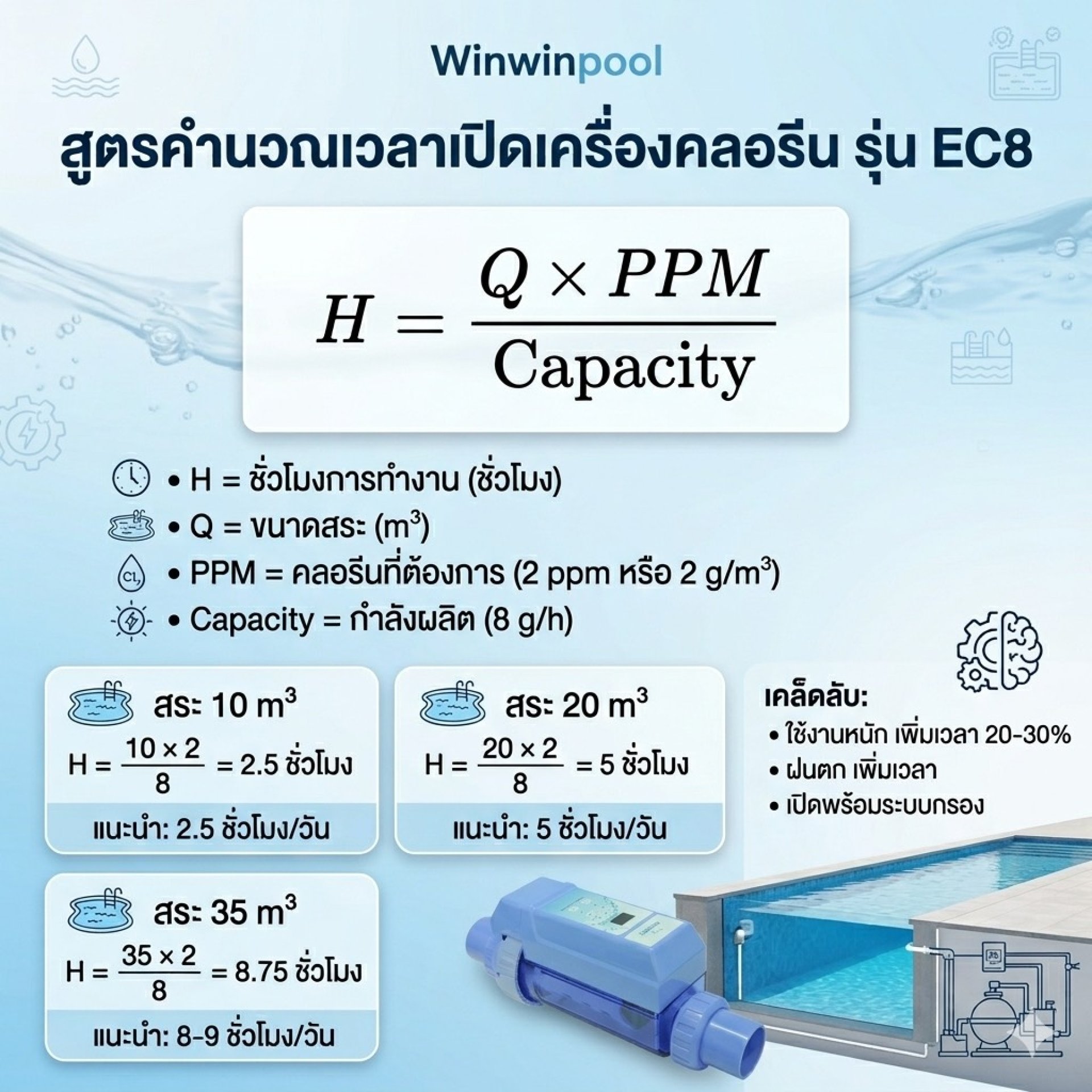
♂️ Salt Chlorinator Running Time Formula (EC8 Model)
One of the most common questions pool owners ask is:
“How many hours should I run my salt chlorinator to keep the water clean and safe?”

The answer depends on your pool size and the chlorine level required. In this guide, we’ll show you a simple formula and real examples using the EC8 salt chlorinator (8 g/h).
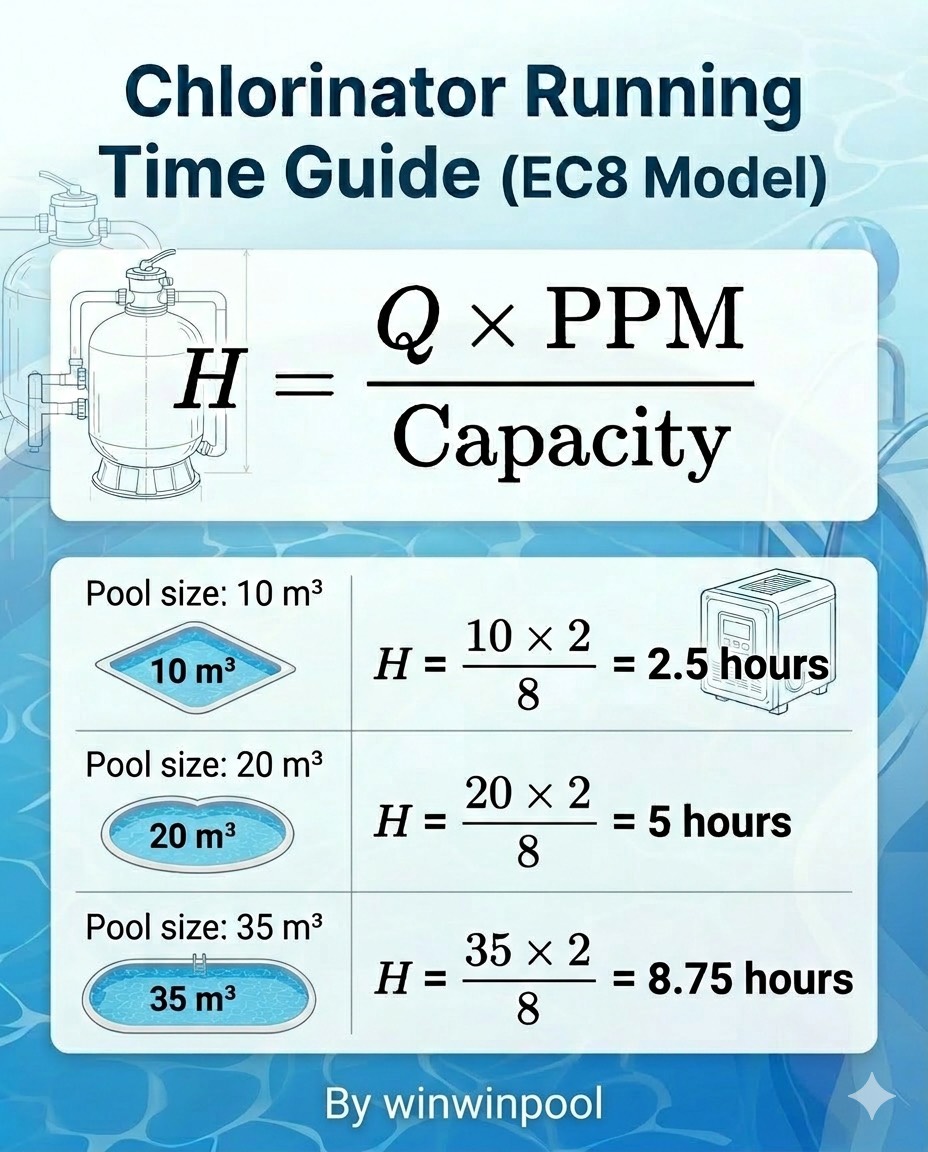


Simple Formula
H = (Q × PPM) / Capacity


Variables Explained
H = Operating time (hours)
Q = Pool volume (m³)
PPM = Desired chlorine level (recommended 2 ppm or 2 g/m³)
Capacity = Chlorinator output (EC8 = 8 g/h)

Practical Examples (EC8 Model)
Pool Size: 10 m³
H = (10 × 2) / 8 = 2.5 hours
✅ Recommended: 2.5 hours per day


Pool Size: 20 m³
H = (20 × 2) / 8 = 5 hours
✅ Recommended: 5 hours per day


Pool Size: 35 m³
H = (35 × 2) / 8 = 8.75 hours
✅ Recommended: 8–9 hours per day


Expert Tips
Increase runtime by 20–30% during heavy pool usage
Extend runtime during rainy or cloudy weather
If water turns green, temporarily increase chlorine level (3–4 ppm)
Always run the chlorinator together with the filtration system

Conclusion
Using this formula allows you to:

Maintain stable chlorine levels
Keep your pool clear, clean, and safe
Avoid unnecessary chemical usage
Optimize energy consumption
Whether you have a small or large pool, setting the correct chlorinator runtime is key to professional-level pool care.


Why Choose EC8 from Winwinpool?
Stable chlorine production (8 g/h)
Energy-efficient and easy to use
Ideal for residential pools
Expert support and consultation available


Shopping EC Salt Chlorinator


Related Content
⭐ **WATERSTOP for Swimming Pool Construction Selection Guide + Specifications (Winwinpool Standard by Pool Size & Concrete Thickness)**
⭐ How to Choose the Right Waterstop for Swimming Pools Selecting the proper waterstop is essential for preventing leakage through concrete joints in swimming pool structures, including floor-to-wall joints, construction joints, and areas with structural movement such as expansion joints. Choosing the correct size and thickness helps ensure long-term waterproofing performance and extends the overall lifespan of the pool. The selection should always match the thickness of the pool wall or slab. For example, 6-inch waterstops are suitable for 15–20 cm concrete walls, while 8-inch models are recommended for 20–25 cm walls. Rib design and thickness are equally important: triple-rib models provide stronger anchorage and are ideal for high-pressure or movement-prone areas, whereas double-rib models suit general construction joints. Winwinpool classifies its waterstops into six types—Type A, AA, B, BB, C, and CC—allowing engineers, contractors, and homeowners to select the most appropriate model according to structural requirements and pool design standards.
Why Choose a Variable Speed Pump? Can It Really Save Electricity? 2026
What is a Variable Speed Pump? How does it work? Comparing SS vs 2-Speed vs VSP in All Dimensions Calculating Electricity Costs and Payback Period Other Benefits of VSP People Often Overlook What Type of Pool is VSP Suitable For? Recommended Best Value VSPs in 2026 Frequently Asked Questions (FAQ)
Swimming Pool Pump
ปั๊มสระว่ายน้ำ Swimming Pool Pump
icon-messenger
This website uses cookies to enhance performance and provide you with a better user experience. You can read more details at: Privacy Policy and Cookies Policy