


EC8 Series Salt Chlorinator, 8 g/h, for Pools up to 35 m³ (Old Model)
SKU : SC-LS-EC8-OLD
1 Sold
Quantity
Short Description
Suitable for pools up to 35 m³. The compact unit requires little installation space and is easy to operate and maintain. The controller is mounted on the cell assembly.
Package dimensions: 16 × 34 × 25.5 cm
Gross weight including packaging: 2.87 kg
Updated: 04/03/2026
Important information about the EC8 Old Model
The product listing states that only one unit is available . Availability may change; please confirm before ordering.
Please confirm the actual unit condition, included accessories, packaging, and warranty terms with the seller. The product listing does not specify these details for this item.
Salt chlorination for small to medium residential pools
The EC8 uses electrolysis to produce sanitizing chlorine from salt dissolved in pool water. Its controller and chlorination cell are integrated to save installation space, and the cell plates are accessible for maintenance. Chlorine generation must operate with the circulation and filtration system; regular water testing is still necessary.
LASWIM EC8 Old Model specifications
| Model / product code | LASWIM EC8 Old Model / SC-LS-EC8-OLD |
|---|---|
| Maximum chlorine output | 8 grams per hour |
| Maximum pool volume | 35 cubic meters (depending on actual chlorine demand) |
| Operating voltage / current | Use only the adapter supplied with the unit. Check the voltage and current shown on the actual equipment label before connecting power. |
| Pipe connection | 1.5 inches / 50 mm. Check the actual union size before installation. |
35 m³ is the maximum pool volume in the reference specifications; it does not guarantee sufficient chlorine output under all conditions. Outdoor or heavily used pools may require a higher output and an assessment of pump run time.
Key features
Choose from five levels using the + and − buttons according to your chlorine test results and pool demand.
Runs at maximum output for eight hours before returning to the previous setting. Test chlorine before and after use.
The automatic cell cleaning function helps reduce scale buildup; the cell still needs periodic inspection.
The display shows error codes for conditions such as insufficient water flow or abnormal salt levels.
The EC Series manual describes an operating time setting of 1–24 hours. Confirm the available settings on the control panel of the supplied unit.
According to EC Series information, the unit recalls its last operating status when switched on again.
Before installation and first use
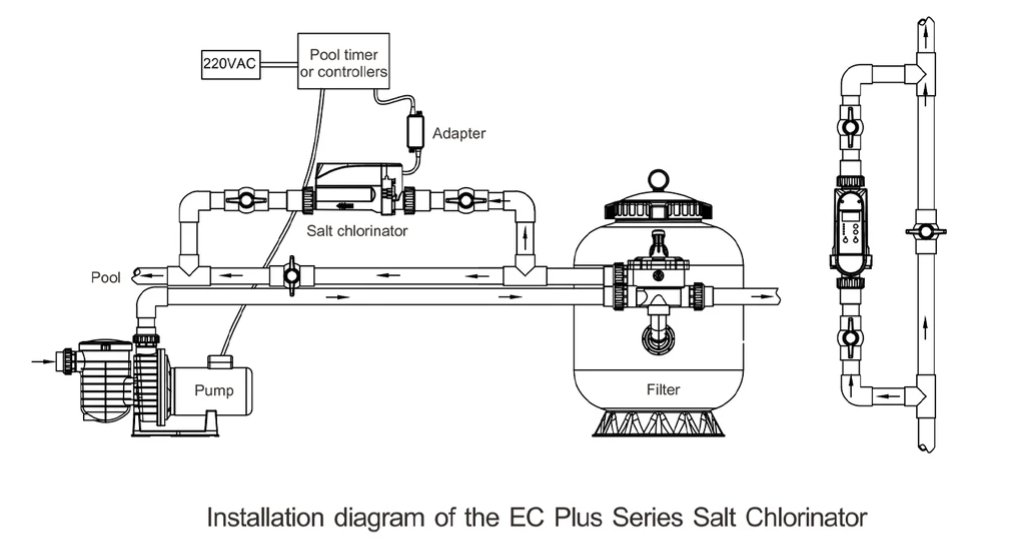
Install in the circulation line after the pump and filter as directed by the manual. Check the flow direction and ensure adequate flow through the cell. Plan any bypass and valves to suit the plumbing layout on site.
02 · Electrical supplyHave a qualified technician check the power supply and supplied adapter. Install residual current protection, and ensure the chlorinator cannot be powered while the pump is stopped.
Choose a ventilated location and protect electrical components from rain, moisture, and splashing. Leave clearance for removing the cell plates.
04 · Check the water firstMeasure salinity and water quality before starting chlorine production. Start the pump and confirm normal water flow through the unit.
Adding salt and maintaining water quality
The EC Series manual gives a reference salt level of approximately 3,500 ppm , equivalent to 3.5 kg per 1 m³ of water. Use swimming pool sodium chloride without unsuitable additives. Always measure existing salinity first to avoid adding too much salt.
Salt to add (kg) = pool volume (m³) × [3,500 − measured salinity (ppm)] ÷ 1,000
Example: a 20 m³ pool measured at 2,500 ppm needs approximately 20 kg of salt to reach the target.
Turn off the chlorinator while adding salt. Keep the circulation pump running and distribute the salt so it does not accumulate on the pool floor. The manual recommends circulating water for 24 hours, then measuring salinity again before switching on the chlorinator. Check free chlorine and pH regularly, and adjust the run time or output according to test results.
Common alert codes
| Code | Meaning | Initial checks |
|---|---|---|
| E2 | Water temperature outside the operating range | Check the water temperature and sensor. |
| E3 | Insufficient water in the cell | Check the pump, valves, air in the pipes, and sensor. |
| E4 | High salt level | Measure salinity with a tester before taking corrective action. |
| E5 | Low salt level | Measure salinity before calculating how much salt to add. |
For other codes, consult the EC Series manual and contact a technician if the issue persists. Do not open the housing or repair electrical circuits while power is connected.
Proper cell maintenance
Inspect the cell periodically and clean it when scale has accumulated. Automatic cleaning helps reduce deposits but does not replace inspection. Before removing the cell, disconnect power, stop the pump, close the relevant valves, and release pressure in the pipes. If a cell cleaning solution is required, follow the EC Series manual and the solution safety instructions. Do not scrub the titanium plates with metal tools.
Frequently asked questions
Can the EC8 be used with a 35 m³ pool?
The product listing specifies pools up to 35 m³. However, sun exposure, bather load, chlorine demand, and pump run time must also be considered. For high demand pools, consider a model with a higher output.
What salinity level is required?
The EC Series manual specifies a normal salt level of approximately 3,500 ppm. Measure before adding salt, then test again after the salt has dissolved and circulated throughout the pool.
Can the chlorinator run while the pump is off?
No. The cell needs adequate water flow. Arrange the electrical controls so the chlorinator operates only while the circulation pump is running.
What should I check before ordering?
Confirm the actual product condition, included accessories, packaging, warranty, and availability before ordering.
EC Series manual (Thai): View the operating manual · Technical information is based on the LASWIM EC Series. Check the label on the actual unit supplied.
EC8 chlorine increase time: worked examples
How long might different pools need to raise free chlorine? Use these initial estimates, then adjust operating time to actual pool conditions.
Simple calculation
- H = estimated run time (hours)
- Q = pool volume (m³)
- ΔPPM = desired increase in free chlorine (ppm) = target reading − measured reading
- Capacity = chlorine output; the EC8 is rated at a maximum of 8 g/h
This formula estimates the theoretical time needed to raise measured chlorine by a given amount. It is not the daily operating time , because chlorine is consumed by sunlight, bathers, and contaminants during use.
Worked examples for three pool sizes
Assume free chlorine starts at 0 ppm, the target is 2 ppm, and the EC8 operates at its maximum output of 8 g/h.
| Pool volume | Calculation | Theoretical time |
|---|---|---|
| 10 m³ | (10 × 2) ÷ 8 | 2.5 hours |
| 20 m³ | (20 × 2) ÷ 8 | 5 hours |
| 35 m³ | (35 × 2) ÷ 8 | 8.75 hours |
If measured chlorine is 1 ppm and the target is 2 ppm, use ΔPPM = 1, rather than 2. Test again to adjust actual run time.
WINWINPOOL practical tips
- Frequent pool use or strong sun: test chlorine and adjust production time according to the results.
- Frequent rain: test free chlorine and pH before changing the run time.
- Water turning green: check chlorine, pH, and filtration to identify the cause. Do not simply target 3 ppm without testing the water.
- Always run the chlorinator with the circulation pump.
In brief
A smaller pool needs less time than a larger one for the same increase in chlorine. The formula provides an initial estimate; set daily operating time according to actual pool conditions and water test results.
Why choose the EC8 from WINWINPOOL?
- Maximum chlorine output of 8 g/h according to the product listing
- Adjustable chlorine production level
- The listing specifies pools up to 35 m³, subject to actual operating conditions
- Our team can help with model selection and settings
Ask about the model and availability
Interested in the EC8 Old Model? Contact WINWINPOOL on LINE @winwinpool to check its condition and size it for your pool.
Related Products

EC20 Series Salt Chlorinator, 20 g/h, for Pools up to 85 m³ (Old Model)

EC16 Series Salt Chlorinator, 16 g/h, for Pools up to 68 m³ (Black Inner Cell)
EC20 Series Salt Chlorinator, 20 g/h, for Pools up to 85 m³

BLUE SEA Solar Pool Ionizer – Solar Powered Copper Ionization System
