Scientific Article: Is a 100% Chemical-Free Swimming Pool Possible? The Scientific Facts and the Role of NSF 50
Is a 100% Chemical-Free Swimming Pool Possible?
The Scientific Facts and the Role of NSF 50
The concept of a 100% chemical-free swimming pool has become increasingly popular, especially among systems using Ionizer + Oxidizer + Ultrasonic technologies and referencing the NSF/ANSI 50 certification. However, it is important to interpret these claims correctly based on scientific principles to ensure user safety and proper water hygiene.
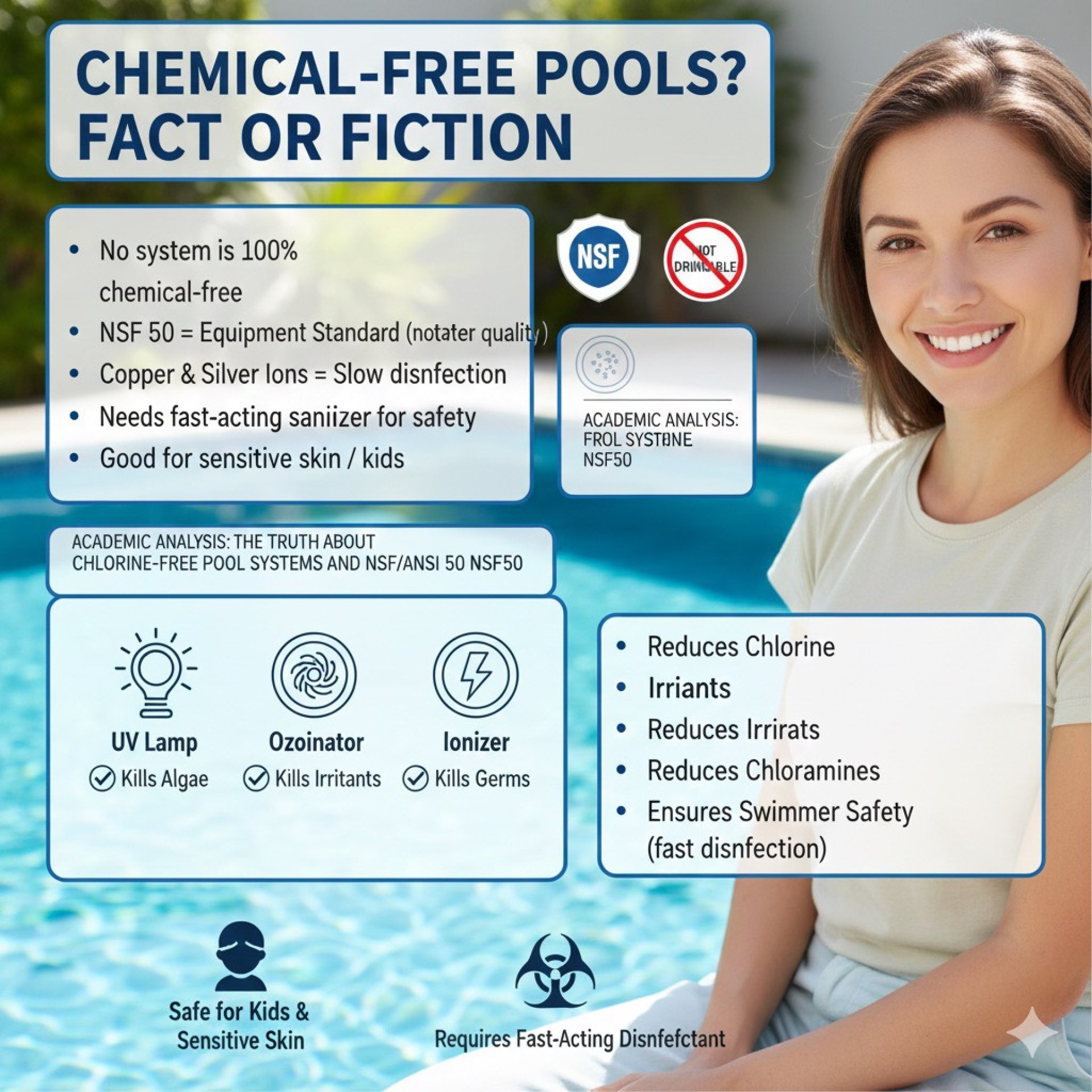
1) No swimming pool system is truly 100% chemical-free
Even systems marketed as chlorine-free still rely on other chemical agents, such as:
Copper ions (Cu²) for algae control
Silver ions (Ag) for bacterial inactivation
Non-chlorine oxidizers to break down organic contaminants
CO for pH control
Therefore, a swimming pool cannot be completely chemical-free. What can be achieved is significantly reducing chlorine usage to minimize irritation to the skin, eyes, and respiratory system.
2) NSF/ANSI 50 is an equipment standardnot a water quality standard
Many consumers mistakenly believe that NSF 50 means drinking-water quality. In reality:
The standard applies to equipment such as filters, UV systems, ozone generators, ionizers, pumps, and other pool components
It does NOT certify that pool water is as clean as drinking water
It does NOT guarantee that the water is 100% pathogen-free
Correct interpretation: NSF 50 ensures equipment performance and safety, not water safety levels.
3) Ionizer + Oxidizer + Ultrasonic: Benefits and scientific limitations
Benefits:
Significantly reduces chlorine usage
Minimizes skin, eye, and respiratory irritation
Reduces chloramine formation
Suitable for children, sensitive skin, and pets
Limitations:
Copper & silver ions disinfect slowly (hours, not minutes)
Non-chlorine oxidizers act slower than chlorine or ozone
Ultrasonic technology does not directly kill pathogens; it only helps reduce biofilm
These systems are suitable for private residential pools but may not provide adequate protection for high-bather-load environments such as hotels, schools, or gyms.
4) Safe swimming pools require a fast-acting primary disinfectant
Public health organizations such as WHO, CDC, and APSP state that:
A swimming pool must have a fast-acting primary disinfectant.
This is essential because contamination occurs continuouslyfrom saliva, sweat, urine, open wounds, and microorganisms introduced by swimmers.
Fast-acting disinfectants include:
Chlorine
Ozone
AOP (UV + Ozone)
Without a rapid disinfectant, pathogens like E. coli, Pseudomonas, Legionella, and Cryptosporidium may persist and pose health risks.
Thus, even low levels of fast-acting disinfectants are crucial for safety.
5) Why these systems are still beneficial for children and sensitive skin
Dramatically reduced chlorine levels
No chloramines (the main cause of odor and irritation)
Gentler water feel on the skin
Ideal for families with young children or elderly users
Balanced Scientific Conclusion
No swimming pool can be 100% chemical-free
NSF 50 certifies equipmentnot water quality
Ionizer systems reduce chlorine but disinfect slowly
For safety, a fast-acting disinfectant is still required
Best suited for private residential pools with low to moderate bather load