Share

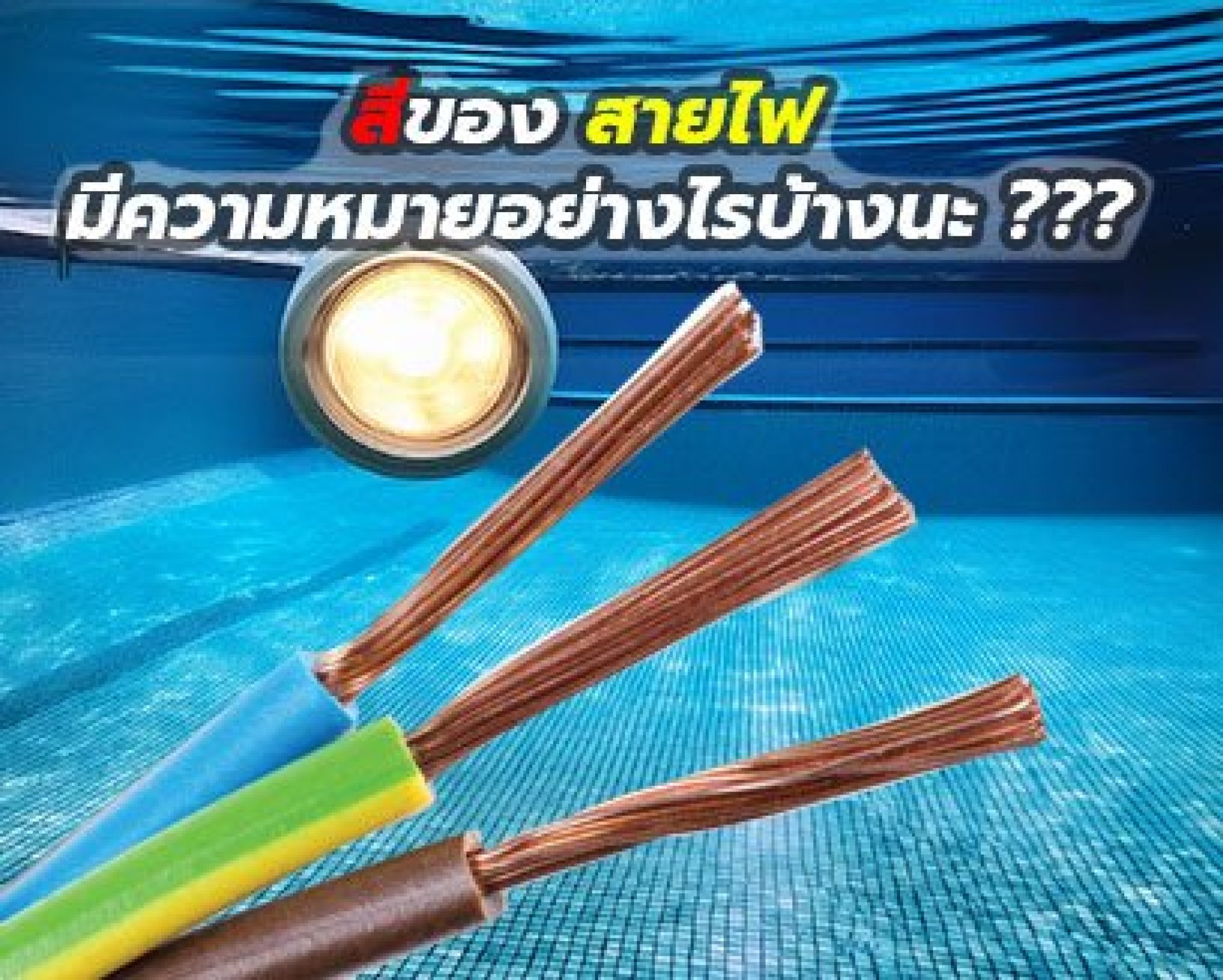
What do the colors of the wires mean?
Last updated: 2 Dec 2025
14087 Views

Electrical Wire Color Standards 

          Currently, electrical wire color standards have changed to use TIS 11-2553 (MOG), replacing the original standard TIS 11-2531. The reason for this change is that the Thai Industrial Standards Institute (TISI) aims for both industrial and household wiring in Thailand to meet international standards (IEC 60227 Standards).
      Many people may wonder if each wire color has a specific meaning. This article will help resolve these doubts by explaining the meaning of each wire color for easier and safer application.

Black (Changed to Brown) refers to the hot wire or the wire carrying current to the entire circuit; usually supplies power to outlets or electrical switches.

Red (Changed to Black)  refers to the second hot wire for large electrical appliances such as air conditioners, ovens, televisions, etc.

Blue and Yellow (Changed to Grey)  refers to hot wires used with portable electrical devices utilizing general plugs, such as fans, lamps, vacuum cleaners, etc.

White or Grey (Changed to Blue)  refers to the Neutral wire, which is essential for the safety of electrical appliances.

Green refers to the Ground wire, which helps prevent electric shock and protects against dangers from short circuits or fires.

According to Thai standards, wire colors can be classified as follows:


Wire Colors 

Black (Changed to Brown) means  L or L1, Positive Current Wire 1 (Live 1) 
Red (Changed to Black) means L2, Positive Current Wire 2 (Live 2) 
Blue (Changed to Grey) means L3, Positive Current Wire 3 (Live 3) 
White or Grey (Changed to Blue) means N, Low Voltage Negative Potential (Neutral) 
Green or Green/Yellow Stripe (Designated as Green/Yellow) means G, Ground Wire, helping prevent danger from short circuits or fires. 
 

Differences between Single-Phase and 3-Phase Systems 

Single-Phase System ( 220 V ) 

Live Wire (L) insulation is Brown 
Neutral Wire (N) insulation is Blue 
Ground Wire (G) insulation is Green with Yellow Stripe 

3-Phase System ( 380 V ) 

Live Wire (L1) insulation is Brown 
Live Wire (L2) insulation is Black 
Live Wire (L3) insulation is Grey 
Neutral Wire (N) insulation is Blue 
Ground Wire (G) insulation is Green with Yellow Stripe


Related Content
Bromine คืออะไร?
#ทำหน้าที่เหมือนคลอรีนแต่กลิ่นฉุนน้อยกว่ามากๆ   #โบรมีนฆ่าเชื้อโรคในสระน้ำอุ่น #สปา #สระในร่ม #สระในอาคาร แนะนำให้ใช้โบรมีนแทนคลอรีน   #ระคายเคืองน้อยกว่า #ปลอดภัยกว่าคลอรีน   #นิยมใช้ในอเมริกา ยุโรป มานาน
สาเหตุ Error Code P เครื่องเกลือ Zodiac eXO iQ คืออะไร แก้อย่างไร?
Kindly perform the following checks: Ensure that the pool circulation pump is operating. Verify that all relevant valves are fully open. Clean the pump strainer basket and the skimmer basket. Release any trapped air from the pump housing. Inspect the flow sensor to confirm that it is clean and unobstructed. If the issue persists after completing these steps, please inform us and we will arrange for a technician to conduct a detailed inspection. Thank you."**
 “Salt Chlorinator Cell Housing Cracked… The Real Cause Is NOT a Bad Machine — It’s When the Unit Runs Without Water Flow!” Many pool owners experience this and get shocked…
A cracked or burst salt chlorinator cell housing is a problem that shocks many pool owners. The chlorinator appears to be running normally, but suddenly you hear a loud “pop,” followed by water leaking from the system. Many people assume the unit is low quality, but in most cases, the real cause is not the machine itself — it is when the salt chlorinator continues operating without actual water flow through the cell. Even when water is not flowing, salt water may still remain trapped inside the cell housing. If the chlorinator keeps producing chlorine from this trapped water, chlorine quickly turns into chlorine gas. The gas pressure builds up rapidly inside the housing, which can eventually crack or explode the clear plastic outer chamber. The most common situations include: (1) closing the inlet and outlet valves during pool vacuuming to prevent sediment from entering the cell, then forgetting to reopen them; and (2) running filter backwash in AUTO mode where the pump and chlorinator operate together, but the water flows directly to the waste line instead of passing through the cell. This issue is especially common in models that use electrode-type water sensing, which can be inaccurate when water is trapped but not flowing. The best solution is choosing a salt chlorinator with a real Flow Switch, such as the Laswim SR Series. A Flow Switch instantly stops operation when there is no real water flow, significantly reducing the risk of cracking, leakage, and costly repairs while extending the equipment lifespan.
icon-messenger
This website uses cookies to enhance performance and provide you with a better user experience. You can read more details at: Privacy Policy and Cookies Policy