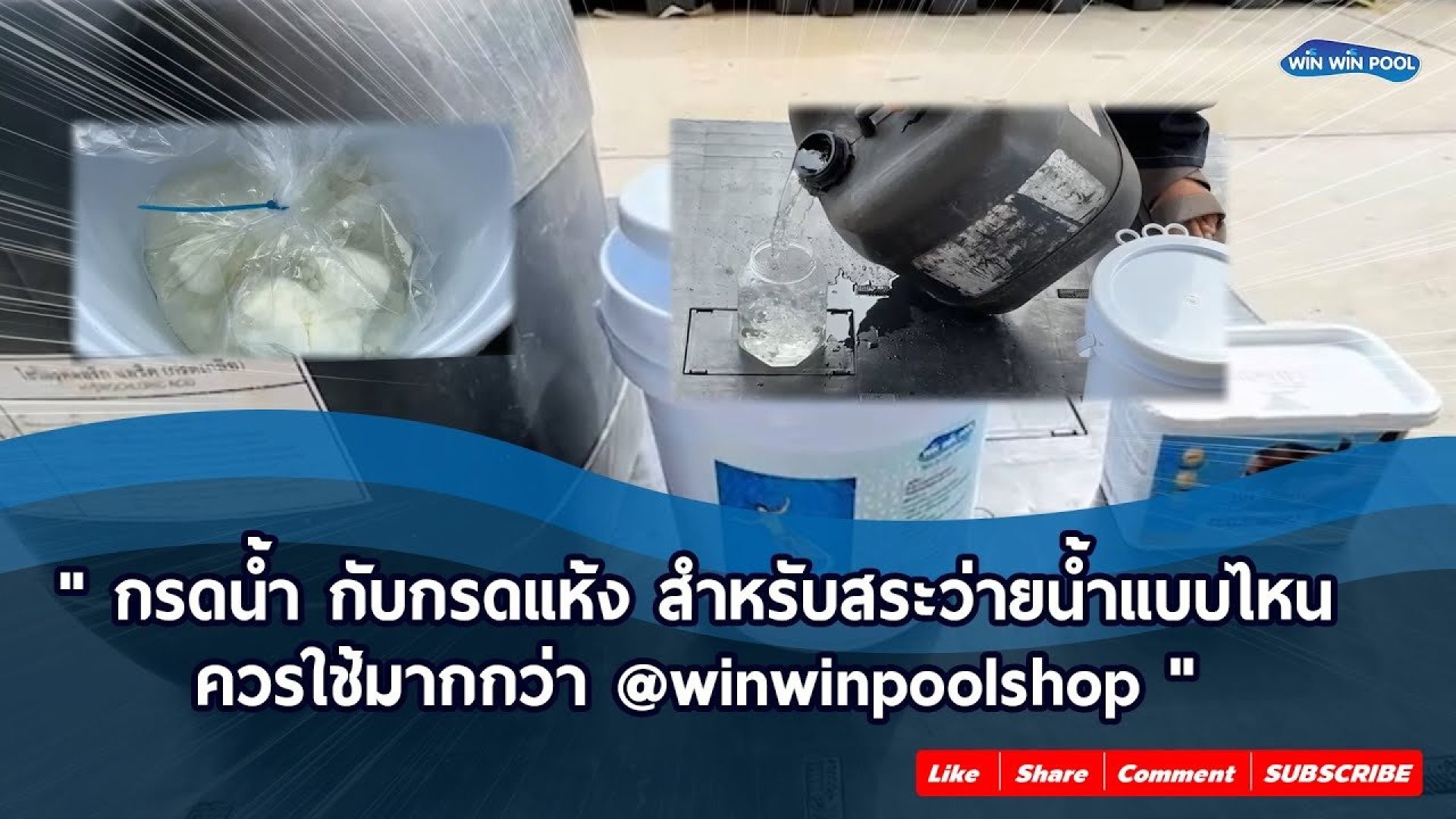
กรดน้ำ กับ กรดแห้ง" สำหรับสระว่ายน้ำแบบไหน ควรใช้มากกว่า?
Last updated: 6 May 2025
190 Views

ข้อเปรียบเทียบระหว่างกรดน้ำ(กรดเกลือ ) VS กรดแห้ง (โซเดี่ยมไบซัลเฟต)
| กรดน้ำ (กรดเกลือ) | กรดแห้ง (โซเดี่ยมไบซัลเฟต) | |
| ความเข้มเข้ม | สูงสุด 35% | 93% |
| อยู่ในรูป | ของเหลวใสอมสีเหลือง /มีควัน | เกล็ดผงสีขาว/ไม่มีควัน |
| การกัดกร่อน | กัดกร่อน | กัดกร่อน |
| การจัดเก็บ | ภาชนะที่มิดชิด ห้ามมีรอยรั่ว เก็บในร่ม/อันตรายกว่า | ปิดฝาไม่ให้อากาศเข้า/ ปลอดภัยกว่า |
| การคงตัว | ความเข้มขันลดลงได้มากกว่าแบบแห้ง | ค่อนข้างจะคงที่มากกว่า |
| WinwinPool แนะนำ | ไม่แนะนำ เพราะอันตรายกว่า | แนะน่าเพราะปลอดภัยกว่า ความเข้มข้นสูงกว่า ใช้งานง่ายกว่า |
Related Content

The New Year holiday is a time when many families travel to other provinces or overseas, leaving their homes unoccupied for several days. For homeowners with swimming pools, this often leads to concerns that the water may turn green, develop unpleasant odors, or require costly cleaning and water replacement upon return.
In reality, closing a swimming pool for 7–10 days is not difficult if the correct water care principles are applied. The key is proper water preparation before leaving, using the right chemicals to work in place of daily maintenance. This approach helps control algae growth, bacteria, and the accumulation of dirt during periods when the pool is not in use.
This one-time, 10-day pool care method is designed for residential pools and can be applied to both homes without automatic control systems and those equipped with Smart Home or Smart App monitoring. It allows pool owners to reduce system operation while still maintaining stable water quality throughout the holiday period.
When chemicals are selected correctly and adjusted according to pool size, homeowners can return from their trip to find clear, clean water. With minimal effort—such as vacuuming settled debris—the pool is ready for immediate use, eliminating the need for draining or refilling and ensuring a stress-free return home.
⭐ How to Choose the Right Waterstop for Swimming Pools
Selecting the proper waterstop is essential for preventing leakage through concrete joints in swimming pool structures, including floor-to-wall joints, construction joints, and areas with structural movement such as expansion joints. Choosing the correct size and thickness helps ensure long-term waterproofing performance and extends the overall lifespan of the pool.
The selection should always match the thickness of the pool wall or slab. For example, 6-inch waterstops are suitable for 15–20 cm concrete walls, while 8-inch models are recommended for 20–25 cm walls. Rib design and thickness are equally important: triple-rib models provide stronger anchorage and are ideal for high-pressure or movement-prone areas, whereas double-rib models suit general construction joints.
Winwinpool classifies its waterstops into six types—Type A, AA, B, BB, C, and CC—allowing engineers, contractors, and homeowners to select the most appropriate model according to structural requirements and pool design standards.
Chlorine 90% is an essential primary sanitizer for every swimming pool, regardless of whether it uses a salt system, mineral system, ionizer, ozone, UV, or other health-oriented treatment systems. These systems function as secondary sanitizers and cannot kill bacteria as rapidly as chlorine. If the water becomes cloudy, develops an odor, or experiences heavy usage, chlorine should be added immediately to restore water quality. Maintain a minimum chlorine level of 0.5 ppm to protect swimmers from newly introduced contaminants. Keeping chlorine in stock ensures your pool remains safe at all times. Store chlorine in a dry area, tightly sealed, and away from moisture. If you need guidance on dosage or product selection, feel free to ask anytime.